Effective Field Theories (EFT) of
Non-Relativistic Systems
Compton scattering and nucleon
polarisabilities in
Effective
Nuclear Theory, an
extension of Chiral Perturbation Theory to include nucleons.
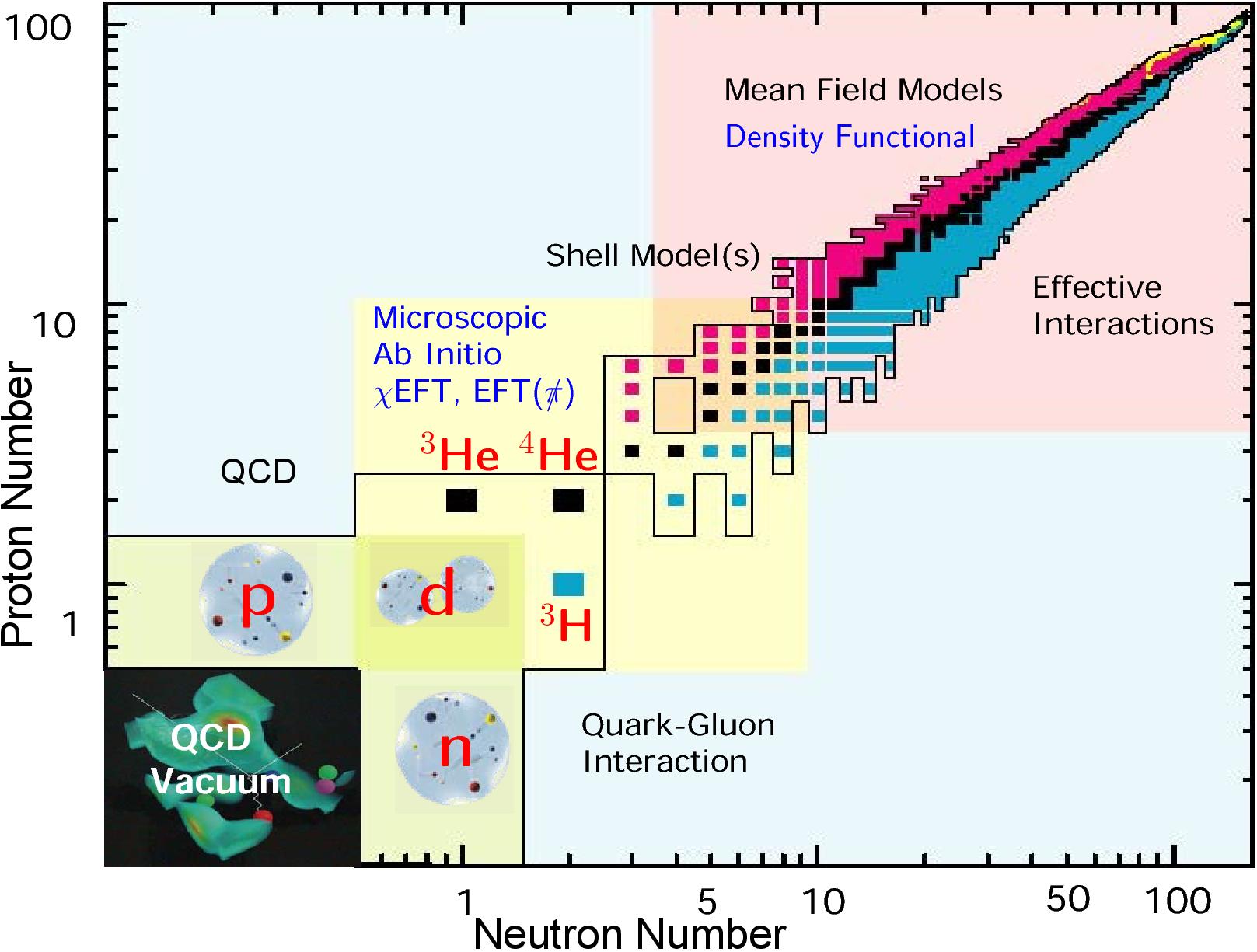
Two, three and a-few-more nucleon systems at very low energies
in Effective Nuclear Theory. Especially:
Deuteron, Triton and Helium-3 probed with electromagnetic and weak
currents.
Nucleons
and nuclei in small boxes in Effective Nuclear
Theory, also relevant to lattice extractions.
Nuclear
Matter with EFT.
Non-relativistic
QCD: The EFT of QCD in systems of two or
more heavy quarks. Especially: Conceptual problems (classification of
different
regimes, beta function, renormalisation properties). Since the
underlying theory, QCD, is known, this helps one understand any EFT of
non-relativistic systems. How to calculate scattering amplitudes in
systems of heavy quarks using a non-relativistic prescription.
Non-perturbative
Physics of QCD (ancient)
Instantons, theta
vacua, U_A(1) problem
Dual Meißner
Effect ('t
Hooft-Mandelstam
Mechanism) for Confinement in Abelian Projections in the continuum.
Non-perturbative gauge fixing in the Hamiltonian and
Lagrangean Formulation of QCD.
And what else?? I don't know
yet...
Lectures
and Teaching
The material in this Section is originally based upon work
supported by the
US National Science
Foundation under CAREER award PHY-0645598. Any opinions, findings, and
conclusions or recommendations expressed in this material are entirely
mine and do not necessarily reflect the views of the National Science
Foundation.
Graduate Curriculum
In 2008, GW Physics introduced a "Two-By-Four"
Graduate Curriculum and Qualifying Examination Format, with the
goal to escape 60-year-old habits in US Graduate education. The new
curriculum:
is
based in the strong conviction that Physicists are highly valued in
both Academia and Industry as All-Rounders, and should therefore have a
rounded understanding of all aspects of the discipline, as learned in a
compulsory set of core-lectures;
increases lecture time from 3 to 4 hours per week to allow for
more depth and cautious additions of more modern material;
decreases
the number of parallel courses from 3 to 2 to allow for better focus
and reduce "parallel-processing" of seemingly unrelated courses;
emphasises synergies between courses (e.g. computational
component integrated into core);
stresses that the course sequence should follow a logical order,
with each course as stepping stone to the next semester;
views the core-curriculum as bridge to research;
thrives
to better and faster immerse students into research by integrating
recent developments important for research in the department;
aims to foster "research skills": abstraction & reduction to
essence, independence, team-work, communication.
A presentation with more details and the new course sequence is
available as .pdf file
here.
Courses and Manu-Scripts
Lecture
Manu-Scripts:
This material is based upon work supported by the US National Science
Foundation under CAREER award PHY-0645598. Any opinions, findings, and
conclusions or recommendations expressed in this material are entirely
mine and do not necessarily reflect the views of the National Science
Foundation.
Chapter-by-chapter manuscripts are available in .djvu format (http://djvu.sourceforge.net/).
Follow the links of chapter headings below, or at the course
websites.
Caveat:
Warning and Disclaimer
These are my notes for
preparing the class, in my handwriting. While considerable
effort has been invested to ensure the accuracy of
the Physics presented, this script bears only witness of my limited
understanding of the subject. I am most grateful to every reader who
can point out typos, errors, omissions or misconceptions. Maybe over
the years, with lots of student participation, this can grow into
something remotely useful.
The script only intends
to ease the pain of following the lecture, and does
not replace the thorough study of textbooks.
The
script is not
intended to be comprehensible,
comprehensive -- or even useful.
It is
certainly not legible. Your mileage will vary. This
script is not useful or relevant for exams of any kind.
Best
Practice Read over the
manuscript before class. Try to grasp the
essential points. The better prepared you are, the more we can focus
on discussing your questions and observations, and solve problems. The
class
becomes more interactive and thus more fun -- and therefore you learn
more. Study details of the manuscript after the lecture, and follow the
derivation of all formulae line-by-line. This is excellent and free
exercise for your math skills, and makes sure you not just "read
along".
It is also the starting point
for your own literature research using good books like those
recommended for particular subjects in the "Suggested Reading" columns
at the course websites.