Frank Baginski
Department of Mathematics
The George Washington University
Hall of Government
Room 224
2115 G Street NW
Washington, DC 20052
Phone: (202) 994-6269
Fax: (202) 994-6760
Email: baginski@gwu.edu
Spring 2014
Math 6330 Section 10 - Ordinary Differential Equations
Tu & Th 09:35-10:50
in 1957 E, Room 310
Information
on Careers in Mathematics
Previous Courses
Math 6340 (formerly 221) Modern Partial Differential Equations
Math 231 Topics in Applied Mathematics
Research Interests
The advancement of materials and technology
in thin light-weight films has generated great interest in
deployable space structures for a variety
of applications, including inflatable rovers, inflatable antennas,
airbags to cushion landings,
aerobots, planetary and terrestrial balloons. Current research
interests
focus on the development of a mathematical
model for high altitude balloons used by NASA to support
research in the upper atmosphere.
To take full advantage of current balloon technology or develop new
balloon designs, it is important to have
a valid mathematical model for estimating maximum stresses
and strains that are experienced by the
balloon film prior to launch and during its ascent to float altitude.
The problem is complicated by the fact
that the balloon film can fold back upon itself and wrinkle
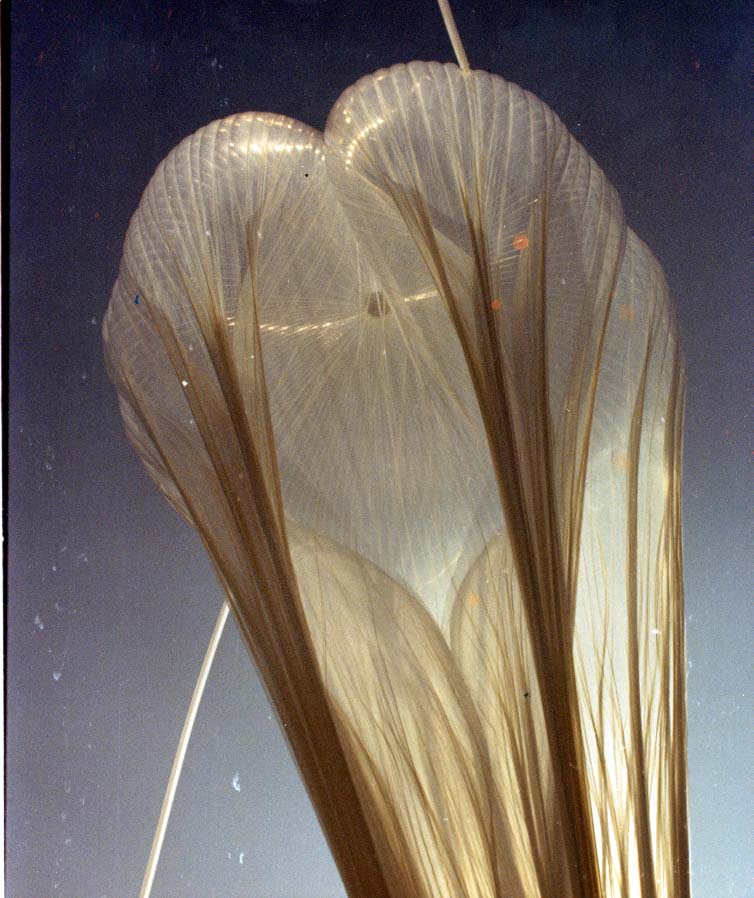
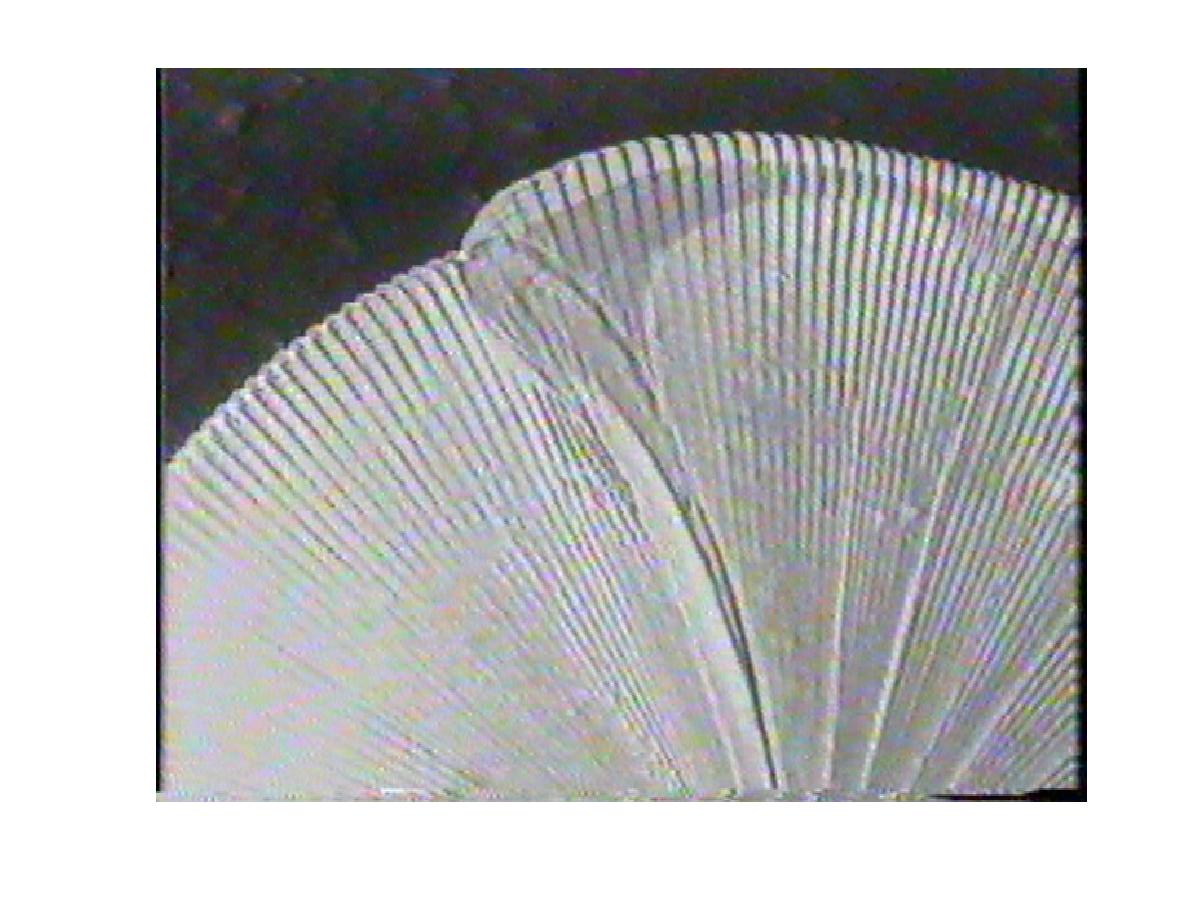
(see the images below). The balloon problem
generates a wealth of challenging
mathematical problems in differential
geometry, the mechanics of membranes, and direct methods
in the calculus of variations.
|
|
|
A large scientific balloon
at launch
|
An undesired equilibrium
configuration at float altitude
|
Recent work on large super pressure pumpkin
balloons, focusing on questions of stability, sensitivity
analysis, the formulation of undesired
stable equilibria (see above), and the deployment problem.
Long term success of the pumpkin
balloon for NASA requires a thorough understanding of the
phenomenon of multiple stable equilibria.
For an ultra long duration balloon (ULDB) mission of 100 days or
longer, there is a need for design criteria
that will enable the designer to arrive at structurally efficient designs
while providing sufficient margins against
the occurrence of instability, and in the case of a visco-elastic
film
also accounting for the service
lifetime configuration changes of the balloon.
For more on scientific ballooning
see the following links:
NASA Balloon Program
Office
NASA Columbia Scientific Balloon
Facility
Selected Publications
-
Numerical investigations of the role of curvature in strong
segregation problems on a given surface,
co-authored with R. Croce, S. Gillmor and R. Krause, Applied Mathematics and Computation,
227 (2014) 399-411.
-
The effect of boundary support, aperture size and reflector depth on the
performance of inflatable elastic parabolic antenna reflectors,
co-authored with K. Brakke, AIAA J. of Spacecraft and Rockets,
49 No. 5 (2012) 905-914.
-
Deployment of Pneumatic Envelopes Including
Ascending Balloons and Inflatable Aerodynamic Decelerators,
co-authored with M. Coleman and R. Romanofsky, AIAA J. of Spacecraft and Rockets,
49 No. 2 (2012) 413-421.
-
The ExaVolt Antenna: A Large-Aperture, Balloon-embedded Antenna
for Ultra-high Energy Particle Detection,
co-authored with P. W. Gorham, P. Allison, K. M. Liewer, C. Miki, B. Hill, and G. S. Varner,
Astroparticle Physics, 35 No. 5 (2011) 242-256.
-
Solving period problems for minimal
surfaces with the support function,
co-authored with V. Ramos Batista, Adv. Appl. Math. Sci.,
9 No. 1 (2011) 85-114.
-
Modeling the equilibriium configuration of a piecewise-orthotropic
pneumatic envelope with applications to pumpkin-shaped balloons,
co-authored with M. Barg and J. Lee, SIAM Journal on Applied Mathematics,
71 No. 1 (2011) 20-40.
-
Exploring the stability landscape of constant-stress
pumpkin balloon designs, co-authored with K. Brakke, AIAA
Journal of Aircraft, 47 No. 3 (2010) 849-857.
-
Simulating clefts in pumpkin balloons,
co-authored with K. Brakke, Advances in Space Research,
45 (2009) 473-481.
-
Existence theorems for tendon-reinforced
thin wrinkled membranes subjected to a hydrostatic pressure load, co-authored
with M. Barg and W. Collier, Mathematics and Mechanics of Solids,
13 (2008) 532-570.
-
Unstable cyclically symmetric and stable
asymmetric pumpkin balloon configurations, co-authored with K.
Brakke and W. Schur, AIAA Journal of Aircraft, 44 No. 3 (2007)
764-772.
-
Stability of cyclically symmetric strained
pumpkin balloon configurations and the formation of undesired equilibria,
co-authored
with K. Brakke and W. Schur, AIAA Journal of Aircraft, 43
No. 5 (2006) 1414-1423.
-
Cleft formation in pumpkin balloons, co-authored
with K. Brakke and W. Schur, Advances in Space Research, 37 (2006)
2070-2081.
-
On the design and analysis of inflated
membranes, SIAM Journal on Applied Mathematics, 65 No. 3 (2005),
838-857.
-
The natural shape balloon and related models,
co-authored with J. Winker, Advances in Space Research, 33 No. 10
(2004), 1617-1622
-
Structural analysis of pneumatic
envelopes: Variational formulation and optimization-based solution process,
co-authored
with W. W. Schur, AIAA Journal, 41 No. 2, February 2003, 304-311.
-
Special functions on the sphere with applications
to minimal surfaces, Advances in Applied Mathematics
28
(2002) 360-394.
-
Modeling the shapes of constrained partially
inflated high altitude balloons, co-authored with W. Collier,
AIAA Journal 37 No. 9 (2001), 1-11; ``Errata'', AIAA Journal,
40 No. 6 (2002), 1253
-
Modeling the design shape of a large
scientific balloon, co-authored with Q. Chen and I. Waldman,
Applied Mathematical Modeling 25 (2001) 953-966
-
Modeling ascent configurations of strained
high altitude balloons, co-authored with K. Brakke, AIAA
Journal, 36 No. 10 (1998), 1901-1910.
-
A parallel shooting method for determining
the natural-shape of a large scientific balloon , co-authored
with W. Collier and T. Williams, SIAM Journal on Applied Mathematics,
58 Number 3, June 1998, 961-974.
-
Numerical solutions of boundary value problems
for K-surfaces, co-authored with N. Whitaker, Numerical
Methods for Partial Differential Equations,
12 (1996), 525-546.
-
The computation of one-parameter families
of bifurcating elastic surfaces, SIAM Journal on Applied Mathematics,
54
No. 3, (1994), 738-773.
-
The buckling of elastic spherical caps,
Journal of Elasticity, 25 (1991), 159-192.